


The Journal
Metapsychologica is an independent editorial project launched in 2019 as an initiative of the Scuola di Psicanalisi Freudiana (SPF). The journal aims to foster the kind of interdisciplinarity deemed essential for the training of psychoanalysts—a necessity already emphasised by Sigmund Freud in the 1927 Postscript to The Question of Lay Analysis (1926):
A scheme of training for analysts has still to be created. It must include elements form the mental sciences, from psychology, as well as from anatomy, biology and the study of evolution.
Accordingly, Metapsychologica serves as a multidisciplinary forum for bringing together these diverse fields of knowledge, which are necessary for constructing a new naturalistic paradigm underpinning a theory of subjectivity. This theory aspires to open new avenues of research not only in cognitive and clinical domains, but also in ethical, ethno-anthropological, and social contexts.
The call
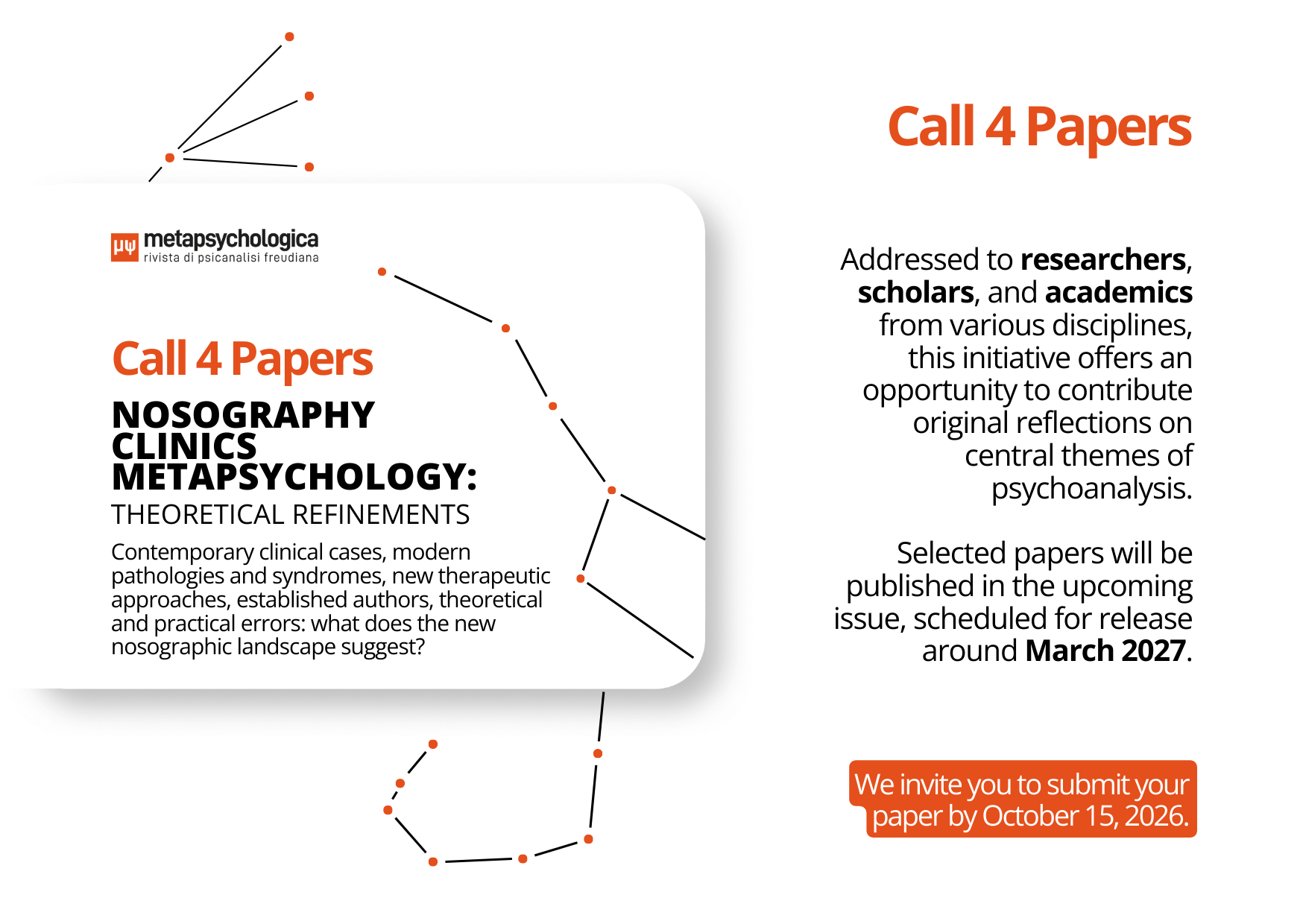
The 2025/26 seminar of the School of Freudian Psychoanalysis proposed a course of reflection devoted to the relationship between nosography, clinical practice, and metapsychology.
The lectures provided an opportunity to critically re-examine certain contemporary trends in theory and clinical practice, in particular the progressive shift toward predominantly descriptive and classificatory models, often detached from a solid etiological framework. In this context, engagement with classical nosography and the Freudian metapsychological framework made it possible to reopen the debate on the explanatory value of the fundamental concepts of psychoanalysis and on their continued relevance.
Attention focused, among other aspects, on changes introduced in diagnostic manuals, on the difficulties these changes pose for a causal understanding of psychopathological phenomena, and on the clinical and theoretical implications of such transformations. At the same time, the seminar explored the relationships between clinical practice and theory, the role of metapsychology in interpreting phenomena not exclusively clinical—including socio-economic ones—and the relationship between interpretative models, method, and technique.
This plurality of questions highlighted the need for a space of discussion capable of fostering rigorous and interdisciplinary dialogue. Metapsychologica therefore intends to offer its pages as a meeting place for researchers and scholars from the psychoanalytic field and from other disciplines, grounded in the conviction that scientific progress is nourished by critical engagement between diverse theoretical perspectives.
Psychoanalysis, understood as a discipline that takes the subject as its object of study, continues to raise questions of major epistemological and gnoseological significance that cut across the human and natural sciences as a whole. From this perspective, the journal welcomes contributions that aim to explore, discuss, or problematize these issues, without allegiance to any particular school or orientation, provided that a rigorous argumentative method is respected.
We therefore invite submissions of theoretical essays, clinical contributions, and historical or interdisciplinary studies that may be situated, by way of example and not limitation, along the following thematic axes:
- Epistemological foundations of psychoanalysis
The scientific status of psychoanalysis, criteria for theoretical validation, and the relationships between epistemology, gnoseology, and clinical practice.
- Psychoanalytic clinic and theoretical models
Analysis of clinical cases; reflections on the relationship between phenomenological description, theoretical structure, and clinical effectiveness.
- Freudian metapsychology and theoretical dialogue
Critical engagement between Freudian metapsychology and other psychoanalytic, psychological, or neuroscientific models.
- Contemporary nosology and psychopathology
Critical analysis of current diagnostic categories; relationships between symptom, structure, and etiology; theoretical and clinical implications.
- History of nosography and diagnostic classifications
Paradigm shifts, continuities, and ruptures between classical nosography and contemporary diagnostic systems.
- Psychoanalysis and data sciences
Possibilities, limits, and epistemological implications of the use of statistical models, data science, and quantitative approaches in the study of psychic phenomena.
- Psychoanalysis, artificial intelligence, and models of intelligence
Comparison between artificial intelligence, computational models, and living intelligence; theoretical, clinical, and epistemological issues.
- Probability theory and models of uncertainty
Applications and limits of probability in understanding clinical, decisional, and diagnostic phenomena.
- Psychoanalysis and complex systems theory
Systemic approaches, non-linear dynamics, emergence, and complexity in the theory and clinical practice of the subject.
The editorial board of Metapsychologica hopes that this call will foster an open and fruitful scientific exchange, capable of contributing to the theoretical and clinical development of the discipline and to dialogue with other fields of knowledge.
Further resources
Editorial Guidelines
All contributions submitted to the journal must be original and unpublished; if accepted for publication, they may not be reproduced elsewhere without the prior consent of the editorial board.
All submissions will be subject to peer review.
The maximum length of contributions is 13,000 words for texts in Italian and 12,000 words for texts in English.
Submissions that do not comply with the editorial guidelines or are not prepared in accordance with the journal’s template will not be considered for publication. Further information is available at the following link:
https://www.scuoladipsicanalisifreudiana.it/metapsychologica/criteri-redazionali/
Deadline
All contributions must be received by the editorial board no later than 15 October 2026.
Paper submission
To submit your work, use this form, or email your document and CV to info@scuoladipsicanalisifreudiana.it
Contacts and info
- website: www.metapsychologica.it
- email: info@scuoladipsicanalisifreudiana.it