

The Journal
Metapsychologica is an independent editorial project launched in 2019 as an initiative of the Scuola di Psicanalisi Freudiana (SPF). The journal aims to foster the kind of interdisciplinarity deemed essential for the training of psychoanalysts—a necessity already emphasised by Sigmund Freud in the 1927 Postscript to The Question of Lay Analysis (1926):
A scheme of training for analysts has still to be created. It must include elements form the mental sciences, from psychology, as well as from anatomy, biology and the study of evolution.
Accordingly, Metapsychologica serves as a multidisciplinary forum for bringing together these diverse fields of knowledge, which are necessary for constructing a new naturalistic paradigm underpinning a theory of subjectivity. This theory aspires to open new avenues of research not only in cognitive and clinical domains, but also in ethical, ethno-anthropological, and social contexts.
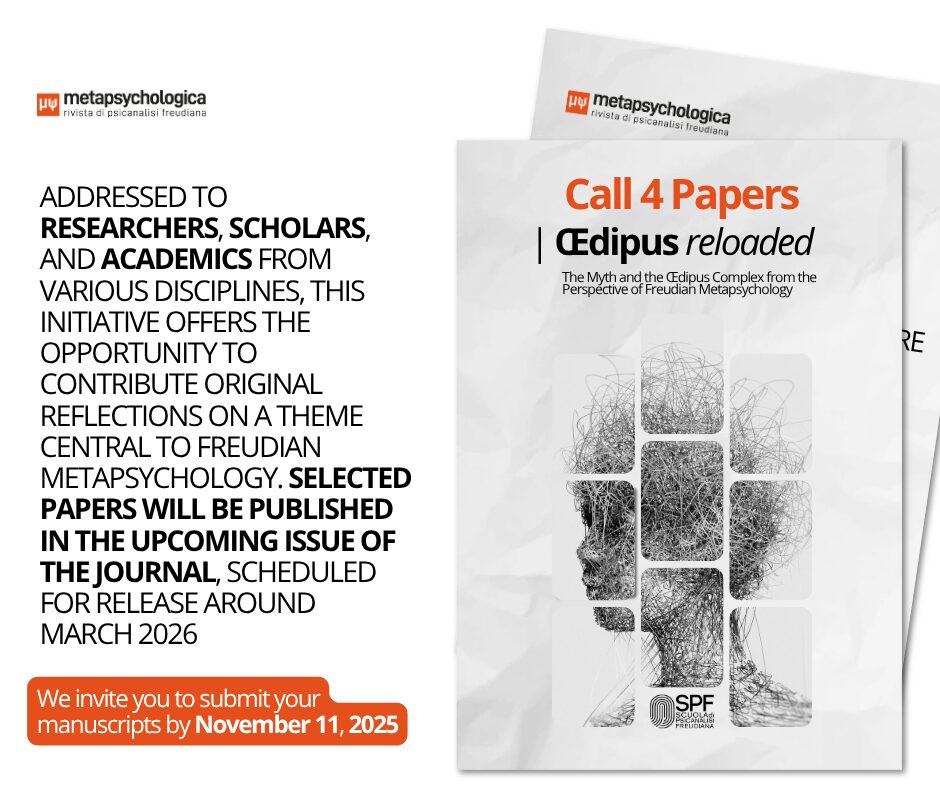
The Call
The theme of Oedipus was the subject of theoretical exploration during the 2024/25 seminar of the Scuola di Psicanalisi Freudiana (SPF). The choice of this topic was intended to challenge centuries of banalisation and clarify certain misunderstandings that have plagued Freud’s theory of the Oedipus complex.
This led the seminar to engage with a number of readings that have become canonical within academic discourse. Indeed, more than a century after its formulation—and following waves of criticism and supposed “refutations”—the seminar revealed that, when tested against more rigorous argumentation, such critiques often failed to hold up and instead appeared to stem from ideological rejections.
In general, the reception of Freud’s theory of the Oedipus complex has often mistakenly treated it as merely an interpretation of the myth—thus reducing its rich and multifaceted dimensions. While the Oedipus complex may serve as a key to interpreting certain elements of the myth (such as the killing of the father, the incest between Oedipus and Jocasta, and the meaning of Oedipus’s punishment), Freud himself explicitly ruled out any confusion between the myth and the complex. This implies that the Oedipus complex can never be the sole interpretive lens through which to view the myth.
Not only does confusion between the complex and the myth abound, but many of the so-called “academic” readings have shown themselves to be ideologically biased and intellectually evasive when dealing with issues relating to sexuality. Take, for example, the classicist Jean-Pierre Vernant, who—quite inexcusably—displays considerable confusion when handling terms like philia, or other structures of ancient society that, for a scholar of his calibre, should be crystal clear. Or consider the structuralist interpretation of anthropologist Claude Lévi-Strauss, who reduces the issue of incest to a matter of “overvaluation of kinship ties.” Then there’s the reductive reading by philosopher René Girard, who compresses the entire myth into a Catholic-tinged narrative of the scapegoat. These are just a few paradigmatic examples of how some well-established interpretations of the myth, upon closer examination, prove to be fragile and lacking objective foundation.
Moreover, the figure of Oedipus was examined not only in its psychoanalytic formulation as the Oedipus complex, but also in its many mythological, ethno-anthropological, clinical, ethical, and cultural branches.
These investigations have prompted the editorial team of Metapsychologica to seek deeper engagement and dialogue with a broader circle of researchers who share the same need for greater epistemological awareness. The goal is to contribute to the study of Oedipus not solely from a strictly psychoanalytic standpoint, but also from other disciplines (such as anthropology, sociology, philosophy, ethology and biology, comparative mythology), provided these remain in dialogue with the specific Freudian metapsychological approach.
We therefore invite the submission of in-depth essays addressing the following, non-exclusive thematic axes:
- Between myth and complex: Critical readings and reflections on the reception of the Oedipus complex from the 20th to the 21st century (e.g. Lévi-Strauss, Vernant, Girard, Deleuze and Guattari, Simone de Beauvoir, Judith Butler, etc.)
- Psychoanalysis, anthropology, and primatology: Incest and kinship structures
- Psychoanalysis and feminism: The difference between the male and female Oedipus
- Mass psychology: The Oedipus complex and its impact on social structures
- Psychoanalysis and “gender theory:” The role of the Oedipus complex in psychosexual development
- The father and the primal horde: The epistemological problem of phylogenesis
- The historical and legal evolution of the concept of incest
- Philosophical and scientific influences on Freudian thought (e.g., Kant, Schopenhauer, Nietzsche, Darwin) and the genealogy of psychoanalytic concepts
- Clinical implications of the Oedipus complex
- The role of the Oedipus complex in a psychoanalytic aesthetics
Editorial Guidelines
All contributions submitted to the journal must be unpublished; once accepted for publication, they may not be reproduced elsewhere without prior consent from the editorial team.
All submissions will undergo peer review.
The maximum length for contributions is 13,000 words for texts in Italian and 12,000 words for texts in English.
Submissions not complying with editorial guidelines or not formatted according to the journal’s template will not be considered for publication. More information is available at the following link:
https://www.scuoladipsicanalisifreudiana.it/metapsychologica/criteri-redazionali/
Deadline
All contributions must be submitted by 15/11/2025.
Submission
To submit your work, use this form, or email your document and CV to info@scuoladipsicanalisifreudiana.it
Contacts and information
- website: www.metapsychologica.it
- email: info@scuoladipsicanalisifreudiana.it